
Primary Mechanisms of Action
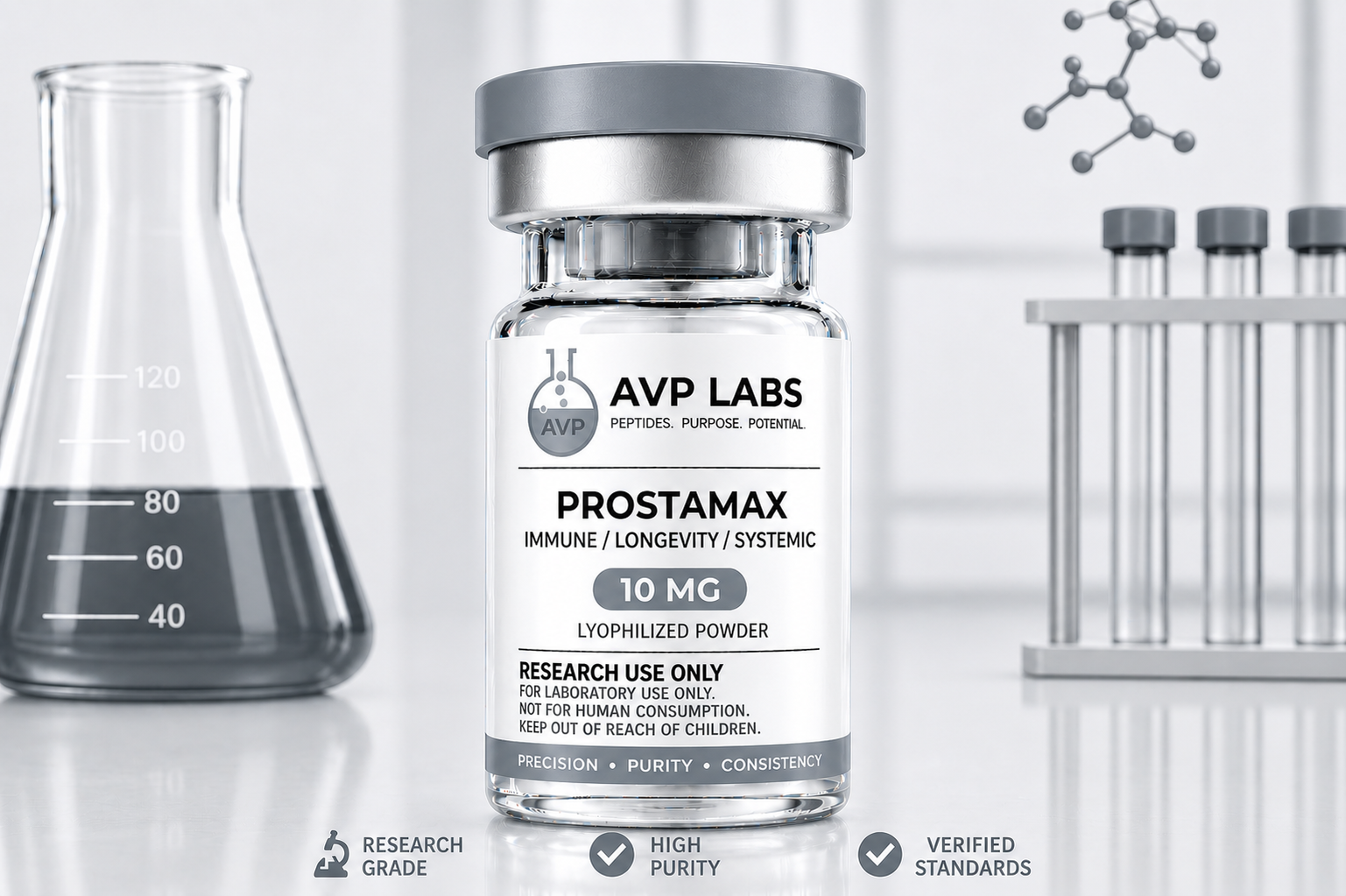
Current scientific literature reveals how Prostamax functions at the cellular level. Specifically, this potent bioregulator activates several critical regulatory cascades:
- Epigenetic Modulation: First, the peptide actively penetrates the cellular nucleus. Inside the nuclear matrix, this interaction powerfully interacts directly with target DNA and histone proteins. As a result, it heavily drives experimental gene transcription in controlled laboratory models.
- Glandular Homeostasis: Next, scientists observe its profound effect on localized tissue regulation. The sequence actively normalizes protein synthesis within specific epithelial cellular models. Thus, it influences complex cytoprotective homeostasis during induced experimental cellular stress.
- Cellular Metabolism Upregulation: Furthermore, laboratory research demonstrates highly selective metabolic action. The sequence actively triggers localized ribosomal function during advanced in vitro cellular communication assays.
Key Research & Study Applications
Because of its unique tissue-specific profile, Prostamax remains a primary focus in advanced biological studies. Scientists actively investigate this peptide across several distinct scientific disciplines:
- Epithelial Tissue Assays: Experts heavily utilize this sequence in specialized glandular models. Specifically, they examine its capacity to trigger precise cellular rejuvenation pathways under exactly controlled laboratory conditions.
- Epigenetic Modeling: Moreover, cellular research focuses closely on fundamental gene transcription. Studies investigate how the peptide influences downstream signaling markers and chromosomal stability during advanced in vitro testing.
- Cellular Senescence Research: Furthermore, laboratories research its broad-spectrum anti-aging effects on a cellular level. They actively observe adaptive physiological changes and cellular longevity under extreme experimental environmental stress.
- Synergistic Protocols: Finally, investigators frequently utilize Prostamax alongside other Khavinson bioregulators (such as Epitalon). Researchers actively use these combinations to quantify precise systemic epigenetic activation in diverse biological tissue samples.
Academic References & Source Literature
To support rigorous laboratory protocols, the following peer-reviewed literature details the in vitro and in vivo mechanisms of the Prostamax sequence and related short-chain bioregulators:
- Khavinson, V. K., et al. (2014). “Short peptides regulate gene expression and protein synthesis in experimental models.” Bulletin of Experimental Biology and Medicine, 156(2), 256-259.
- Lin’kova, N. S., et al. (2014). “Peptide regulation of apoptosis and cell proliferation in the prostate gland.” Acta Naturae, 6(1), 51-55.
- Khavinson, V. K., et al. (2012). “Epigenetic mechanisms of prostate gland regulation by short peptides in animal models.” Advances in Gerontology, 2(4), 284-288.